All posts

Summary
- GiveDirectly has experimented with “cash plus” (cash+) approaches to amplify the impact of cash alone
- Increasingly, we’re expanding our product set to enable more “plus cash” (+cash) approaches – where can cash, delivered alongside other scaled investments and interventions, have outsized impact?
- This is both a symbolic and a substantive evolution in how we think about cash as an enabling and catalytic ingredient in development ecosystems, especially as aid flows recede
- We’re testing new “cash+” approaches in 2026, and are eagerly sourcing partnerships to expand in 2027 and beyond
Development finance is at an inflection point. Aid budgets are contracting. Governments are rethinking what they can afford. Across sectors – health, livelihoods, climate resilience – there’s a growing recognition that the most effective interventions aren’t always the most expensive ones, but the ones designed to work together at scale.
GiveDirectly has spent 15 years proving that cash transfers are among the most effective tools in poverty alleviation. Now I’m increasingly asking a different question: not just “what can cash do?” but “what can cash unlock?”
That question is behind a subtle but meaningful shift in how we’re developing cash-based solutions at GiveDirectly – from “cash+” to “+cash.”
What the Product team at GiveDirectly does
For nearly 15 years, the core of GiveDirectly’s programs has been large cash transfers delivered to all households in poor villages, with no strings attached. The evidence for this model is deep and consistent: lasting increases in income, assets, and consumption. Simple, scalable, transparent. For many donors and recipients, it’s still the gold standard.
Last year, we established a Product team, bringing together our cash delivery technology, research and evaluation, data, and new product verticals under one roof. Our north star is what we call the “green triangle”: the intersection of what’s impactful for recipients, fundable by donors, and feasible to implement at scale. Our job is to find and build at that intersection, with an increasing focus on cost-effectiveness.
The reality is, there’s a limit to how much innovation you can drive with cash alone – small amounts v. big; highly targeted v. not; before a disaster or after. For me, one of the most exciting innovation spaces is around where cash complements other effective, scalable investments and unlocks incremental impact.
Admittedly, when we’ve experimented in “cash+” innovations, we’ve run into constraints inherent in taking anything that works and smushing it together – higher coordination costs, bespoke and layered interventions that can’t scale, things that work in one context but can’t generalize to others, unclear attributable impact. There are myriad ways you can imagine cash interacting with other evidenced interventions to drive outcomes – where is the biggest potential for impact at scale?
“Cash+” v. “+cash”: a distinction that matters
The terms sound similar, but they’re not the same.
Cash+ is about add-ons that make the impact of cash more intense, durable, or predictable – e.g. coaching, information, behavioral support. In this frame, cash is still the main ingredient: the “plus” component extends or amplifies what it can do.
The question is: how do we improve the enabling environment for cash transfers, especially when delivered at scale?
+Cash flips the frame entirely. It asks: where can cash be an enabling factor for other large-scale interventions? Here, cash isn’t the main event. It’s the ingredient that makes the main event work better, reach further, or stick longer.
Cash+ programs center a core intervention that we know is scalable, generalizable, and effective, and we hold a pretty high bar to what we would layer on top of cash. But the +cash frame opens a different kind of conversation: one that takes health systems, infrastructure programs, climate funds, and government policies and considers – how can we make these initiatives more accessible, and more effective, for the extreme poor?
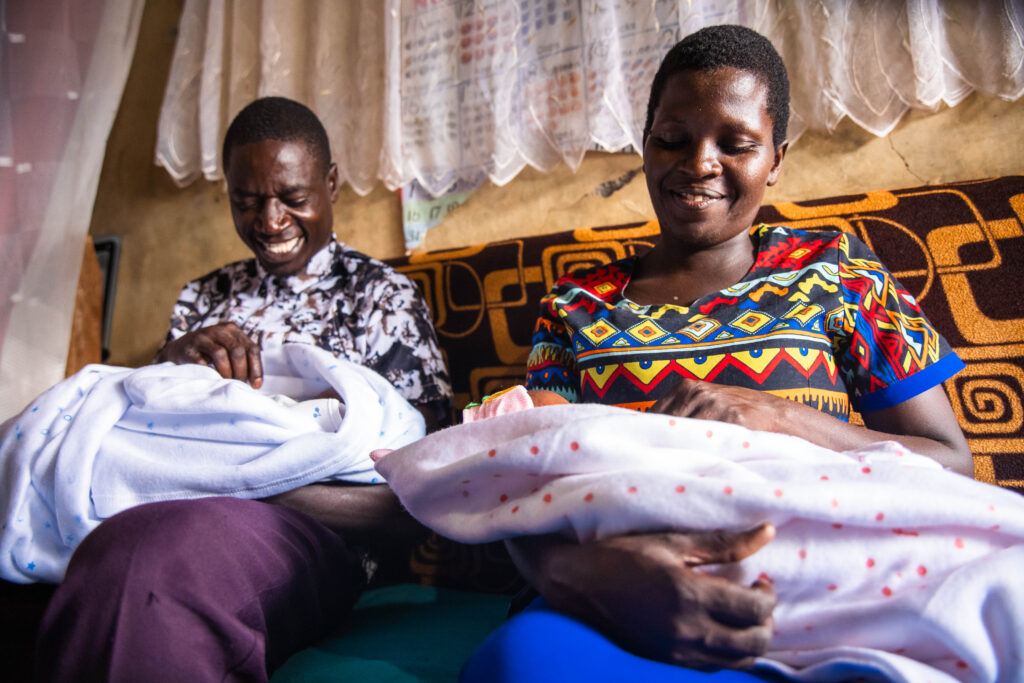
Rose and Samson used their cash transfer to enroll in the Kenyan government’s Social Health Authority insurance scheme. They could finally access medication for their child “without fearing the bill.”
Three ways +cash creates value
When I think about where +cash has the most potential, three mechanisms stand out.
Catalyze. Cash can close the demand-side access gap that would otherwise “zero out” the impact of other interventions. A scholarship covers school fees, but a student can’t afford room and board and drops out. A health system offers free delivery services, but transport costs and insurance fees keep women from making it to the clinic. We’re seeing exactly this in our early Mothers & Babies data from Kenya, where cash during pregnancy is being used to cover insurance enrollment fees, clinic transport, and out-of-pocket medical costs- removing the barriers that would otherwise make a well-functioning health system inaccessible. In these cases, a targeted cash transfer doesn’t compete with the primary intervention. It enables it.
Amplify. Some investments become dramatically more valuable when cash arrives alongside them. New infrastructure – a bridge, a market, a clinic – creates opportunity, but households need resources to act on it. We’re testing this directly: one of our GiveWell-funded pilots in Uganda delivers cash shortly after trail bridge construction connects isolated communities to markets. The hypothesis is that cash enables faster utilization of new market access, generating both immediate consumption gains and sustained economic growth. The combined intervention may outperform either on its own – a genuine 1+1=3.
Derisk. Crises and shocks don’t just cause acute harm – they undo years of prior investment. Each year, millions of people fall back into poverty due to climate events, conflicts, or economic shocks. GiveDirectly is building infrastructure to enable rapid, targeted cash response anywhere in the world within five days. This isn’t just a humanitarian program- it’s an insurance layer for development portfolios. If you’ve spent a decade building health systems, agricultural capacity, or economic resilience in a region, emergency cash is what prevents a single bad season from erasing it.
Why this moment
Three things are converging to make this “+cash” approach particularly timely.
First, technology is enabling combinations that weren’t previously feasible. As more interventions are delivered digitally – health messaging, agricultural extension, financial services – the ability to layer cash into those channels increases. Organizations building digital delivery infrastructure are natural “+cash” partners, and the operational complexity of integration is dropping every day.
Second, aid flows are shifting. Government ODA is contracting in many markets; donors and governments are looking for leverage: scalable, legible interventions that make their other investments go further. “+Cash” is a direct answer to that question. It repositions cash not as a competing use of development dollars, but as a multiplier on them.
Third, the evidence base is building. Our current pilots with GiveWell, our partnership with Lwala Community Alliance, and our Cash + Coaching work are all proof points to demonstrate how cash can integrate into large, multi-component programs without losing what makes it distinctive.
What excites me, and where I’m uncertain
I’m genuinely excited about what this makes possible. The most interesting version of GiveDirectly’s future isn’t cash as a standalone product competing for a share of the development budget. It’s cash as a standard ingredient in how philanthropy and the sector approach poverty alleviation – embedded in health systems, shock response, and job creation – wherever financial resources are the binding constraint between good intentions and actual impact.
I’m also clear-eyed about the risks. Transformational partnerships mean coordination costs. Moving from a simple, scalable model toward more complex combinations requires real discipline to avoid drifting into something slower, more expensive, and harder to evaluate. And, as we optimize for cost-effectiveness as an organization, we’re grappling with these tensions: when do combined interventions drive real gains, for recipients v. serve the interests of donors? Where will gains actually compound with scale, rather than diminish? How can we preserve agency and unconditionality?
I’m thinking carefully about those tradeoffs, and I’ll write more about them soon.