All posts

Summary
- GiveDirectly is testing adding digitizable coaching that supports cash recipients to reach their personal goals to our programs.
- Our aim is to enhance the impact of cash transfers while keeping our programs efficient & scalable.
- We are starting by layering coaching on top of cash in a new $11m program with the Government of Mozambique and the World Bank – and aim to digitize and test programs in other countries.
There is strong, consistent evidence that large, one-time cash transfers increase incomes and reduce extreme poverty. That’s why GiveDirectly is scaling them up across Africa, including through a new $11m partnership with the Government of Mozambique and the World Bank to reach ~33,000 recipients.
With government and World Bank support, we’re pairing cash with coaching to test and learn
Our Mozambique program will test a new capability for GiveDirectly: delivering coaching for recipients.
Why? Because some people are better able to realize their goals when given money and dedicated support. This support may come in many forms – ranging from helping people define their goals and aspirations and overcome common psychological barriers, to helping with planning and budgeting, entrepreneurship, and acquiring skills specific to a job or livelihood.
We want to learn:
- What kind of coaching works best at lifting people out of poverty when paired with cash.
- How to preserve its impacts while delivering it digitally at low-cost – so we can scale it up.
We are offering this support not because we believe people spend unconditional cash in the wrong ways – there is plenty of evidence to counter that perception. Rather, we are doing so because evidence suggests it could help them spend the cash better, in accordance with their own wishes.
We are drawing on the core elements of successful “graduation” package programs
Our cash + digital coaching concept draws on the impacts of a poverty alleviation program called “Targeting the Ultra Poor” or a “graduation” package. These packages aim to help people move out of extreme poverty by combining several types of support:
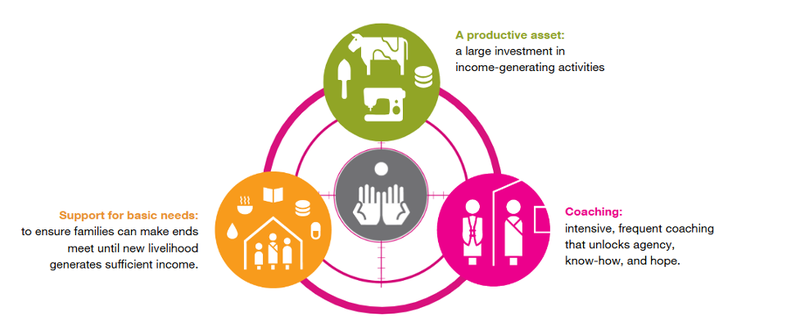
Studies have found that, in some contexts, combining these elements can deliver bigger gains than giving cash alone—particularly for people living in the very poorest households, as identified by their own communities and national surveys.
But these package programs are expensive to run. Coaching, while a critical component of these packages, is also one of the biggest cost drivers. The way that coaching has traditionally been offered, it requires dedicated staff offering in-person support to households over a long period of time.
Our question is: Can you preserve the impact of coaching, while lowering the overall cost and making it easier to scale?
And we’d like to better understand what makes coaching work. “Coaching” means different things in different programs—the content varies, the delivery method varies, and how much coaching people get varies. Are there common elements that make coaching effective across all these variations? If so, which “ingredients” drive most of the impact?
We’re taking these questions seriously. GiveDirectly’s own large lump-sum cash program already contains some of the elements of “graduation” package programs:
- 💰 We split transfers into a smaller first payment and a larger second transfer. Respectively, these two payments are designed to cover the “support for basic needs” and “productive asset” components of “graduation” package programs – but recipients can choose how to spend them.
- 🤝 We also provide light-touch support to help people access and use mobile money banking safely.
About 10 years ago, we evaluated a simple coaching intervention in Kenya, developed and delivered by partners. It was impactful by itself on economic outcomes, but not in combination with cash, and so we didn’t scale it up. Motivated by innovation and progress in the graduation field since then, and the evidence that they have generated, we are ready to try again – this time, delivering coaching ourselves.
We are first testing cash with non-digital coaching in Mozambique, with support from the World Bank
We are starting by pairing cash with a specific type of coaching called “personal initiative training” in Mozambique.
It is an evidence-based approach that draws on psychology to help people build confidence, set goals, and take action. In Togo, for example, personal initiative training for entrepreneurial skills worked much better than formal business training at increasing sales and profits amongst the self-employed.
We are partnering with the nonprofit Doorways to train GiveDirectly staff on how to deliver this kind of support. This program will allow us to build our internal capacity to deliver future digital coaching programs, giving us hands-on experience to better understand which components we may be able to digitize without compromising impact.
We’re building toward digitizing & testing different types of coaching, with support from the Livelihood Impact Fund
We’re also learning from researchers and nonprofits about which coaching approaches work best alongside cash transfers. Thanks to generous support and collaboration with the Livelihood Impact Fund, we are partnering with some of these researchers and nonprofits to test these programs and explore how to deliver them digitally.
There are several additional, high-potential types of coaching in our radar, including:
- 👥 Inter-personal initiative. In contrast to personal initiative training, which tends to emphasize individualism, “inter-personal initiative” or “relational agency” training (developed by Prof. Catherine Thomas and others) helps people build confidence and set goals by emphasizing social roles and the community instead. In Niger, this type of coaching led to significant effects on economic and social outcomes.
- 💪 Self-efficacy, financial planning, and goal-setting. For example, John Hopkins’s SEE Change Initiative’s sessions draw on psychological insights to strengthen individuals’ self-efficacy, financial planning, and goal-setting. In Kenya, their coaching doubled incomes and the “survival rate” of small businesses rose by 50%, compared to standard training.1 It had particularly strong effects on increasing sales amongst women entrepreneurs.
- 📱 Financial and digital literacy. Many implementers commonly include financial and digital literacy content in their “graduation” package coaching programs, including TrickleUp, Village Enterprise, Fundación Capital, and others. Some organizations have already successfully digitized this kind of content in some contexts: Fundación Capital’s tablet-based financial education program had significant positive impacts on participants’ financial knowledge, attitudes, practices, and performance in Colombia, for example.
- 💰 Budgeting and planning with visual aids. Prof. Supreet Kaur and others tested a simple, inexpensive intervention in Zambia using visual planning boards and psychological insights to help individuals think through their budgets and plan their spending, which drastically improved savings among farming households.
- 🧑🤝🧑 Savings groups as a complement. Often, “graduation” package programs also include access to savings groups as a way to complement and deliver coaching content. Organizations such as DreamStart Labs have built ways to help these groups digitally track and manage their savings. In Kenya, Rwanda, and Uganda, DreamStart Labs’ DreamSave app increased savings by 50%.
Many coaching components are or could be digitized – through videos, integrated voice response (IVR), smartphone apps, and AI chatbots.
We’re already piloting digital delivery channels in Rwanda – testing whether AI chatbots can deliver simple coaching content in Kinyarwanda over text, voice notes, or feature phones. Recipients watch a video featuring a past cash transfer recipient’s story and goal-setting prompts, then can ask the chatbot questions.
AI is developing at a fast pace, yet still works best in commonly spoken languages and has other limitations such as expensive delivery over SMS. As more AI chatbots launch in commonly spoken African languages, and as the cost of engaging with chatbots over text goes down, we’ll be able to deliver more evidence-based coaching to cash recipients.
The key is to lower cost and increase scalability without sacrificing impact. We recognize that the effectiveness of a lot of traditional coaching programs could come from the intense, in-person interaction – rather than the content itself. That’s why we expect it will take some time to develop. After first piloting strong coaching products that recipients agree should be scaled, we’d like to iteratively experiment with different combinations – some digital, some in-person, mixing what works best. We’ll test carefully before expanding any AI programs to make sure they actually help.
We want to find the most cost-effective way of lifting people out of extreme poverty at scale
As we develop and test new programs, our goal remains the same: to accelerate the end of extreme poverty globally.
Just as there are limitations to what cash alone may accomplish, intensive package programs also have their challenges: they can be costly and hard to scale.
Bridging the gap between these two types of programs – cash on one hand, and a “graduation” style package on the other – can result in a big win for recipients. If we can successfully combine the scalability and benefits of cash with the enhanced impact of low-cost, high-impact digital coaching, we can help more people escape extreme poverty faster than ever before.
If you would like to partner with us on this agenda, please reach out at info@givedirectly.org.
Appendix
Evidence shows large lump-sums…
💡 Get people out of poverty in the short-term
Unconditional lump-sum transfers help people escape poverty by giving them the freedom to choose how to invest—and a large enough amount of cash to make meaningful investments. Rather than prescribing how funds should be used, these transfers trust recipients to decide what matters most, whether food, housing, education, or small businesses (Cooke & Mukhopadhyay, 2019; Haushofer & Shapiro, 2016; McIntosh & Zeitlin, 2020; IDinsight, 2022).
The evidence is strong: in Kenya, recipients of a $1,000 transfer (roughly equivalent to per-capita GDP) increased spending on food, durable goods, and assets like livestock and transportation (Haushofer & Shapiro, 2016; Egger et al., 2022). Nutrition improved, with food spending rising by $19 and protein consumption by $5 a month (Haushofer & Shapiro, 2016). Overall household spending rose by 23%, including on school supplies and clothing (Haushofer & Shapiro, 2016).
These gains—documented across multiple contexts—appear within 9 to 19 months and often persist beyond the short term (Cooke & Mukhopadhyay, 2019; IDinsight, 2022; McIntosh & Zeitlin, 2022; Banerjee et al. 2020; Collishaw et al., 2024).
💡 Have sustained effects on livelihoods
Large lump-sum transfers do more than meet immediate needs—they support long-term improvements in income and livelihoods. Recipients often invest in productive assets, training, or businesses that increase earning potential over time.
- 🇰🇪 In Kenya, initial analyses suggest a $1,000 transfer led to persistent effects 5-7 years later: recipient villages had higher population, more small enterprises, and greater revenues from both farm and non-farm businesses (25% and 12% higher, respectively). Profits for non-farm enterprises rose by 18% (Egger, et al 2023).
- 🇺🇬 In Uganda, recipients of large one-time transfers launched businesses or moved into higher-paying jobs, resulting in a 71% increase in household income within 12–15 months (Cooke & Mukhopadhyay, 2019; IDinsight, 2022).
- 🇲🇼 In Malawi, households invested in agricultural inputs and other productive assets (Collishaw et al., 2024).
- 🇷🇼 In Rwanda, recipients expanded businesses and grew assets, with average net worth rising by over $355 after 40 months (McIntosh & Zeitlin, 2020; McIntosh & Zeitlin, 2022).
Together, these results suggest that large lump-sums can catalyze economic mobility by enabling forward-looking investments.
💡 Are more effective at increasing livelihoods and investments than smaller, recurring transfers
Larger, one-time transfers have been shown to generate greater gains in income and investment than smaller, recurring payments (Haushofer & Shapiro, 2016; Kansikas et al., 2024).
- 🇷🇼 In Rwanda, researchers tested transfer sizes from $317 to $750 and found that only the largest transfers had lasting effects on income and assets after 3.5 years (McIntosh & Zeitlin, 2022).
- 🇰🇪 In Kenya, recipients who received $500 as a lump sum had better economic outcomes than those who received the same amount in smaller monthly installments over two years (Haushofer & Shapiro, 2016).
- 📚 A review of 115 cash programs similarly found that larger transfers produced greater gains in investment and self-employment than smaller ones (Crosta, et al 2025).
Smaller, recurring transfers can still play a critical role in helping households meet short-term needs. However, we are prioritizing larger transfers that enable investment, not just consumption. This also reflects recipient preferences: one study found 95% of recipients favored a single large payment over smaller monthly disbursements.
💡 Boost local economic growth
Large lump-sum transfers can stimulate local economies, generating benefits well beyond the households that receive them. By increasing demand for goods and services, these transfers support local businesses, create jobs, and raise incomes across entire communities.
- 📈 In rural Kenya, each $1 delivered led to $2.40–$2.58 in local economic growth—more than double the original transfer amount (Egger et al., 2022). Recipients spent their transfers on food, tools, and services from nearby vendors and workers, boosting business revenues and creating ripple effects across the local economy (Haushofer & Shapiro, 2016; Cooke & Mukhopadhyay, 2019; IDinsight, 2022). Non-recipient households also benefited, with average income gains of $225—higher than the $136 increase among recipients themselves (Egger et al., 2022).
- 🫰 Crucially, this surge in spending did not cause inflation: prices rose by less than 1%, and there were no adverse effects on local credit markets (Egger et al., 2022).
These findings suggest that well-designed cash programs can generate significant local multipliers without distorting markets.
- The standard training “included 4 days of instruction (approximately 32 hours of training) and covered the following topic areas: (a) starting a viable business as well as aspects of business growth; (b) a refresher introduction to basic business skills, including effective record keeping and basic accounting skills and cash management; (c) business planning, creation of action plans; (d) basic financial management skills; and (e) understanding the customer and review of group action plans.” ↩︎