We give cash directly to people living in extreme poverty
Since 2009, we’ve delivered over $1 billion to more than 2 million people, with no conditions on how they spend their cash. Backed by more than 200 independent studies, ‘no-strings’ cash has the strongest evidence base of any anti-poverty program.
Cash 101
Unconditional cash empowers people in poverty to choose how to best improve their lives
Traditional aid often decides what people need and how they should use it. But people living in poverty are the experts in their own lives, and deserve the freedom to choose how best to improve them.
Giving cash is:
- 💸 Simple. There are no middlemen. Your donation goes directly to someone in need, efficiently delivered via mobile money.
- 🔬 Proven. Cash has been studied more than any other anti-poverty program, and it often outperforms traditional aid.
- 📈 Transformative. The impact starts immediately and lasts for years. Up to 12 years after receiving cash, recipients earn more, save more, and weather crises better.
- 🎯 Efficient. More than $87 of every $100 you give to our Poverty Relief programs reaches someone in extreme poverty as cash. For comparison, the UN World Food Programme delivers cash aid at 76% efficiency, and food aid at 45%.
- 🌍 Scalable. The resources to close the poverty gap already exist. They’re just not reaching the people who need them most.
The research, including our own, shows that people use cash on medicine, livestock, school fees, solar panels, irrigation, motortaxis, new businesses and more.
Mobile phones
Your donation arrives as a text message on a basic phone
Mobile money launched in Kenya in 2007 and now serves more than 640 million people, over half of them in sub-Saharan Africa.
It works over SMS on phones that cost ~$15. Users simply dial a short code, enter a recipient’s phone number, specify an amount, and confirm with a secure PIN to transfer funds instantly. They can cash out with nearby tellers. No smartphone, internet connection, or bank account needed. For one in three people across sub-Saharan Africa, it’s the first access to financial services they’ve ever had.
Here’s how your donation makes that journey:
| 1. Identify villages We identify areas of extreme poverty and meet with governments & local communities. |
| 2. Meet & enroll people We enroll adults over 18, door to door. Anyone without a phone can buy one from us at bulk cost, deducted from their first transfer. |
| 3. Send payments >87% of your donation goes here. First we send ~$100, then ~$650 two months later, straight to recipients’ phones. |
| 4. Follow up We verify cash was received, respond to call center calls, manage fraud & safeguarding, and track outcomes. |
Watch how mobile phones are changing the lives of people in poverty:
Advanced tech
When crisis strikes, we use AI, satellite imagery, and mobile phone data to find the families hit hardest
Escaping poverty is one thing. Staying out of it is another. Floods, droughts and conflict can wipe out years of gains overnight, and they hit the poorest families hardest. In Malawi, climate shocks pushed four people back into poverty for every three who escaped between 2010 and 2019. That’s why we deliver cash to crisis survivors, and why speed is so important.
But finding the people most in need is the hard part. Most low and middle-income countries don’t have accurate, up-to-date information on household income, and many rely on national social registries created years ago, which can miss families who have just lost work or been displaced.
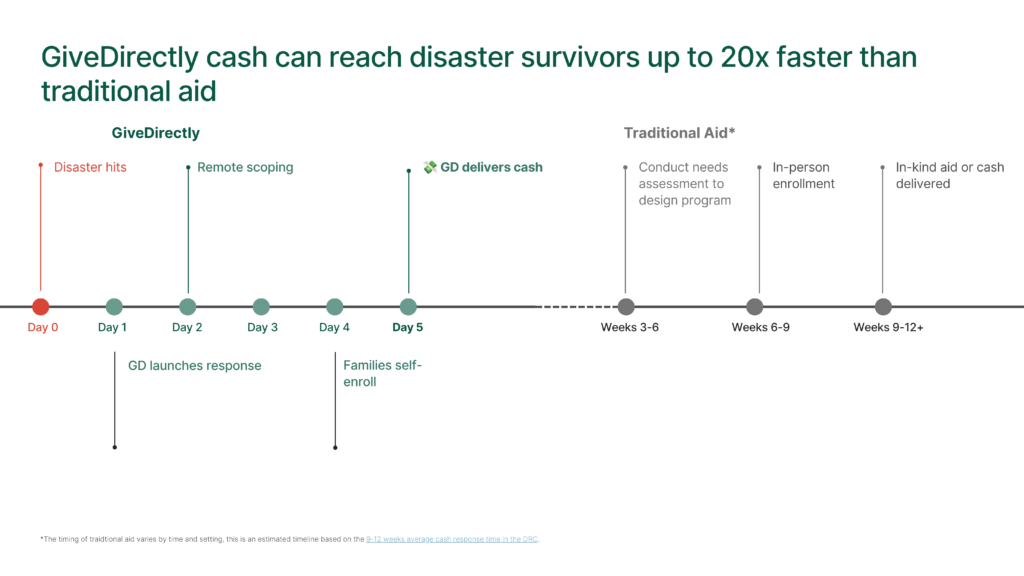
So we look at data that updates in real time: anonymized mobile phone data, satellite imagery, and AI-powered analysis. Together, these tools enable us to identify the poorest families affected by a crisis, often within hours, enabling us to reach crisis survivors much faster than conventional aid.
What this looks like in practice
- In Nigeria, we used Google’s AI flood forecasts to send cash to 4,600 people before the floods peaked. All 53 communities we targeted went on to flood. This early cash helped families evacuate, protect assets, and rebuild — incomes more than doubled and food insecurity dropped from 97% to 7%.
- In Madagascar, satellite data helped us identify the hardest-hit neighborhoods after Cyclone Fytia and deliver cash to 2,108 families just 18 days after the cyclone struck. For comparison, typical flood responses can take 100 to 120 days.
Cash is at least 37.5% more efficient than traditional aid and doesn’t tax fragile supply chains, clog transit routes, or require warehouses full of supplies, yet only ~20% of humanitarian aid is given as cash today. With these tools, we’re closing that gap, with a goal of delivering cash within 5 days of any crisis, anywhere in the world.
See how this technology is transforming emergency aid:
Impacts
Cash improves outcomes for families in poverty and their communities
Studies of GiveDirectly programs have found improvements in health, income, education and entire local economies:
- 👶 Cash saves babies’ lives. A randomized study in Kenya found a $1,000 transfer cut infant deaths by 48%, as mothers worked 51% fewer hours in their third trimester and were 53% more likely to deliver in a hospital.
- ⏳ The gains hold up over time. In Siaya, Kenya, recipients were still spending ~12% more than similar households who did not receive cash up to 7 years later.
- 🇺🇸 Cash works in the U.S. too. A statewide study of our Rx Kids program in Flint, Michigan found preterm births fell by up to 18% and low birthweight births by up to 27%.
- 💰 Local economies grow. In rural Kenya, a one-time GiveDirectly transfer generated 2.5x its value in local economic activity, with minimal inflation.
Recipients also report gains in psychological well-being, food security, education and personal safety. One to two years on, studies of our work find annual income up 50%, savings up 32%, food availability up 13%, and intimate partner violence down 51%.
Hear directly from families in Kenya 10 years after receiving cash:
In the news
Don’t just take our word for it




Ending extreme poverty is more achievable than you’d think
$318 billion a year would almost eradicate extreme poverty. That’s roughly 0.3% of global GDP, or 14% of what the world spends on alcohol. We know cash works, and we’ve built the technology to deliver it at scale. Together, ending extreme poverty is possible.
If you’re interested in making a major gift, please reach out to us at majorgifts@givedirectly.org.