All posts

Summary
- ⚡ GiveDirectly activated an emergency response within 24 hours of Cyclone Fytia’s landfall and deployed a field team in under 3 days to a remote area affected by the storm.
- 💸 2,108 families received ~$67 each1 via mobile money 18 days after the cyclone struck in a country where GiveDirectly had never worked before and had to build a response system from scratch.
- 📲 Local volunteers used tablets and Starlink hotspots to register participants at community gathering points in a context with near-zero digital literacy.
- 👵 In-person registration strengthened inclusion of vulnerable groups. 67% of recipients were women; 19% were older persons (60+).
- 🚀 The response piloted new tools, including Persona for ID verification and Telerivet for communications, and generated hard-won lessons for future emergency cash responses in challenging environments.
Cyclone Fytia struck one of the world’s most vulnerable countries
On January 31, 2026, Cyclone Fytia made landfall as the most powerful storm to strike Madagascar in decades. Severe flooding swept through communities, displacing thousands of people and causing widespread damage to housing and livelihoods.
Madagascar is one of the world’s poorest countries, which makes it especially vulnerable when natural disasters strike. Nearly 7 in 10 people live on less than $3 a day, and many families depend on growing rice to feed themselves and earn a living. Access to banking and other financial services is limited, making it harder for people to save money or recover from setbacks. Many communities also have poor infrastructure, limited access to cash, and low literacy rates, particularly in rural and remote areas.
Within 24 hours of landfall, GiveDirectly activated a response. We sent a team to Marovoay, in Madagascar’s northwestern region, to assess the situation and meet with the community. We set up a program to deliver cash to residents of two neighborhoods that were among the hardest-hit in the cyclone’s path.
Delivering cash in Madagascar required building everything from scratch
Unlike our Philippines response, where relatively high digital literacy rates made remote enrollment possible, Madagascar presented a very different challenge. Lower literacy, limited smartphone access, and weak connectivity ruled out the remote-first model we have used before. This required a more “hands-on” approach.
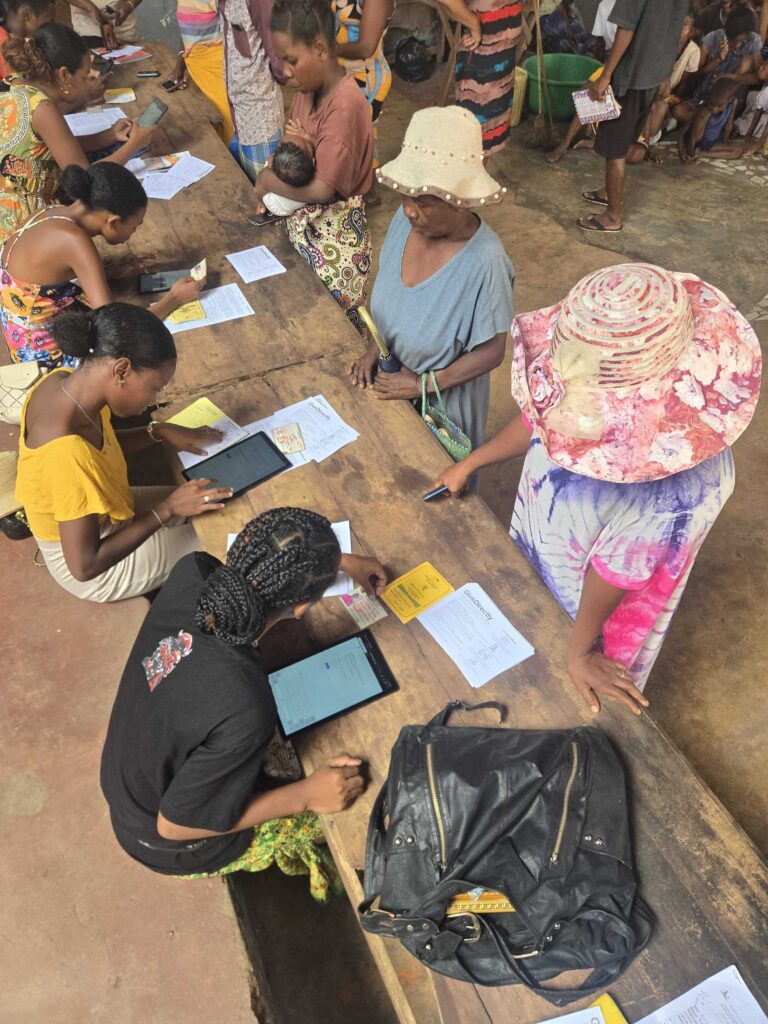
So, our team designed an in-person enrollment model, setting up tablets and Starlink2 WiFi hotspots to register participants. We also worked with local volunteers to help families register for the program on-site.
Here’s how the response worked:
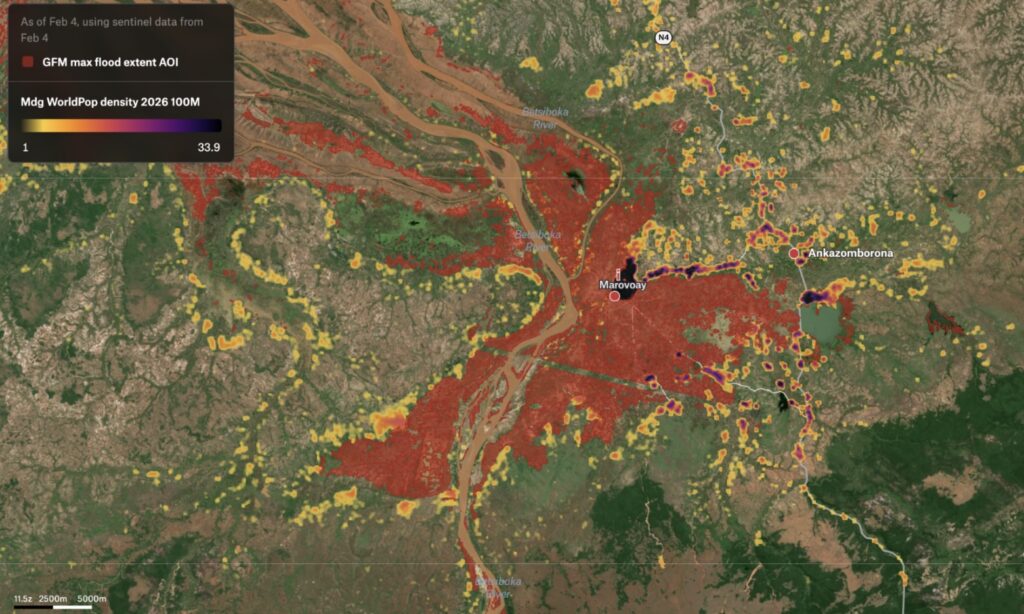
🎯 Targeting: Our team used satellite flood data, population density analysis, and on-the-ground assessments to identify Marovoay’s two most-affected neighborhoods, Morafeno and Tsimajahao. Both areas saw high rates of people forced from their homes, widespread damage to houses and rice fields, and enough mobile banking coverage to make cash transfers practical.
📱 Enrollment: Over 5 days, we worked with local volunteers to register residents at community sites using tablet-based surveys. Re-using tech from our Philippines response and integrating a new ID verification tool lead to 81% of participants automatically passing eligibility automatically, without needing additional verification. At peak, volunteers processed over 500 registrations in a single day.
⚡ Speed: First payments went out on February 18, just 18 days after the cyclone struck. On average, recipients received their payment within 6 days of signing up. By comparison, traditional flood responses can take up to 100-120 days!
💸 Payments: 2,108 recipients received a one-time payment of 280,000 Malagasy Ariary (~$67), an amount set by Madagascar’s national disaster authority. Payments went out primarily through Orange Money; when SIM card shortages limited Orange’s reach, we expanded to Airtel Money to fill the gap.
📞 Helpline & Case Management: A local Malagasy-speaking call center handled 180 cases, everything from failed payments to reports of people impersonating our staff. The setup was intentionally lean but effective, and gave us a clearer picture of what a more reliable global helpline should look like.
Families used cash to put food on the table, repair shelter, and start to recover
When follow-up surveys reached recipients weeks later, the picture was clear: the cash had arrived at a critical moment and helped families purchase urgent needs.
Nearly all respondents (96%) reported buying food and drinking water as their top priority. More than 6 in 10 (62%) used funds for housing and shelter repairs. Others invested in education, business tools, livestock, and healthcare, showing that families directed cash toward their own most urgent needs and personal priorities.
Almost all recipients (99.5%) said the transfer was helpful for their household’s recovery. 97% said their overall sense of wellbeing improved. And 72% said the cash helped them restart or maintain income-generating activities, nearly half of them indirectly, by covering basic needs so they could get back to work.
85% of recipients said the transfer came at the right time. 60% said the amount felt right for their immediate needs.
This response pushed us, and taught us valuable lessons
Madagascar was operationally challenging, and we’re carrying several lessons into future responses:
In-person enrollment improved inclusion. 67% of recipients were women, and 19% were older persons (age 60+), groups who may more likely be excluded by a remote, self-service enrollment process that requires smartphones and mobile data. Volunteer support at registration desks meant that elderly residents and those with low literacy could still participate. This reinforced a principle that runs through our emergency cash work: meeting people where they are and accounting for contextual realities in our program design.
But in-person enrollment also presented risks. Overcrowding at registration sites created safety concerns for both participants and our team. People traveled from outside of the eligible areas hoping to register, some presented fake documents, and tensions rose. Our field team closed registration early to disperse the crowd safely. We coordinated with the local volunteers and neighborhood chiefs to ensure that the stoppage was understood and conducted regular follow-ups. This experience demonstrated both the challenges of in-person programming and the safety benefits of our usual remote program model.
Some governments may not accept our theory that larger cash transfers are more impactful. The Government of Madagascar set the payment amount at $67, which was lower than we would have given to support both immediate needs and recovery. We’re building evidence on transfer size into our learning agenda so we can make the case to skeptical governments over time.
These experiences are shaping how we work. Specifically:
📞 Investing in a global helpline people can actually rely on. Having a direct, reliable way for people to reach us isn’t optional in an emergency, it’s one the hallmarks of GiveDirectly programs. Recipients get a real number to a real person. For this response, we managed to set up a scrappy, functional helpline, but it was fragile.That fragility made clear we need a consistent global solution rather than rebuilding from scratch each time. We’re now integrating WhatsApp for two-way communication in future responses and investing in more durable systems overall.
🗺️ Matching approaches to realities on the ground. In-person registration works well for smaller, geographically concentrated programs — but it doesn’t scale without significant preparation and local presence. Remote registration can cover far more people, but only where people have reliable digital access. We’re building clearer decision frameworks for choosing between the two.
🏛️ Get government buy-in before the emergency, not during it. Navigating government approvals in a difficult regulatory environment was complex — friction that earlier, more deliberate relationship-building could have reduced. We’ve now made early government engagement standard practice across all our emergency responses.
🛠️ Each response makes the next one sharper. This program combined a second outing for some of our tools and the new integration of new tech; ID verification, communications, and our registration forms. The forms, first used in the Philippines, produced noticeably better data quality the second time, showing what’s possible when we build on what we’ve already learned rather than starting fresh.
Fast cash is possible anywhere, if we build the right systems
Madagascar is not an easy place to work. It has some of the weakest infrastructure, most restrictive governance, and lowest digital inclusion of anywhere we have operated. Yet, 18 days after a major cyclone, over 2,100 families had cash in hand.
That matters not just for the families who received it, but as a proof of concept. Emergency cash can reach people in extremely constrained environments. It requires strong teams, adaptable models, and honest learning from what doesn’t work.
As we work toward our five-day emergency cash moonshot, a world where families receive meaningful support within days of a crisis, wherever they are, Madagascar taught us that the path to get there runs through the hardest contexts, not around them.
This response was funded entirely by donors giving specifically to GiveDirectly’s emergency cash work. Website donations default to our poverty relief work in Africa.
- Value set by the Government of Madagascar, the Bureau National de Gestion des Risques et des Catastrophes (BNGRC). ↩︎
- Starlink is a satellite internet constellation operated by SpaceX that provides internet to over 150 countries. Using thousands of satellites in Low Earth Orbit (LEO), it bypasses the need for traditional ground cables, delivering internet access to remote and rural areas. ↩︎