All posts

Summary:
- 💸 Development economics usually treats “micro” and “macro” effects as separate questions. GiveDirectly’s programs are now large enough to blur that divide.
- 🌍 We know our cash programs increase household earnings, spending, and assets. The open question is whether and how new effects emerge when nearly everyone in an economy receives cash.
- 📈 In a district in Malawi, GiveDirectly is testing this directly: cash payments and business investment funding to over 100,000 households, totaling 85% of the area’s yearly income — the largest cash program we’ve ever run.
- 💡 The results of research at this scale could reshape how governments and donors spend billions on ending extreme poverty.
What helps families living in poverty today? What makes economies grow in the long run? Development economics has often treated those two questions separately: one is ‘micro’ economics and the other is ‘macro’ economics. They’re frequently siloed into different textbooks and discrete journals.
For more than a decade, GiveDirectly has built some of the strongest evidence in global development on ‘micro’ issues: large, one-time cash transfers (often worth a year or more of people’s usual income) help households in poverty improve their lives. Yet most of the 1.5 billion people who have escaped extreme poverty since the 1990s did so because their ‘macro’ economies grew, creating jobs, raising wages, strengthening businesses, and opening new opportunities to work or move.
For decades, the community has debated if we should focus on ending extreme poverty with micro solutions or macro ones. I argue this is a false distinction. A macro economy is ultimately made up of the micro households and businesses inside of it. Reach enough of them at once, and those two questions start to converge.
That convergence is what GiveDirectly’s biggest-ever study is designed to test: can direct cash transfers at large enough scale help whole economies move out of poverty?
We know what cash does in pieces. We are learning how those pieces add up to economic growth.
We already have hundreds of studies showing the “micro” effects of cash, meaning what happens inside individual households after they receive it. They earn more, spend more, and own more assets. We know what cash does, and also what its limitations are.
We also have promising evidence that cash can spark changes in local economies. In Kenya, cash transfers increased incomes for both recipients and their neighbors who didn’t receive cash: as recipients spent more, businesses earned more, and that spending circulated through the economy. Every $1 transferred generated about $2.50 in local economic activity, suggesting that household gains can spread more broadly and contribute to economic growth.
What we still know less about is what drives these economy-wide changes, and how many places in the world are ripe for that kind of market-wide impact to take hold. With GiveDirectly programs getting larger across enough different contexts, we can start asking better and more detailed questions about how economy-wide changes take place, and what it would take for those changes to stick.
What role can cash play in ending extreme poverty?
Operating at this scale requires a completely different set of questions. Open any of the five below to see what each one covers and how we’re testing it now.
1 Can cash, at large enough scale, change how a whole economy works?
What this covers
When enough money reaches one area, the effects spill beyond individual households: new businesses, jobs, and a shift from farming toward manufacturing and services. It also weighs the risks, like whether prices rise, and how big a program must be before these effects show up.
How we’re testing
- Large-unit trials in Malawi at Traditional Authority level, plus pilots that give cash to local businesses and producers, not only households
- Satellite imagery, mobile-money records, and economic modeling
- Tracking jobs, businesses, prices, and inflation risk
2 What relationship should large-scale cash programs have with governments?
What this covers
Cash programs don’t operate in a vacuum. This explores where they can complement public systems: shared registries of who needs help, social protection for those least able to escape poverty alone, and health and education services. It also asks what a coordinated path toward a whole region being “out of poverty” could look like.
How we’re testing
- How cash complements social registries and social protection
3 What is the most cost-effective way to design a large-scale cash program?
What this covers
The core design choices behind a large cash program: how big each transfer should be and at what scale, and how those choices change the direct effects on families, the wider spillovers, and the cost — including how cash compares to other approaches like “graduation” programs.
How we’re testing
- New trials in Malawi: Chiradzulu, plus a larger TA-level study
- A/B tests of whether spending suggestions or labelling outperform unrestricted cash
- Cost-effectiveness pilots run in partnership with GiveWell
4 Which families can escape poverty on cash alone, and which need extra support to get there?
What this covers
Cash works better for some families than others. This looks at what share stay out of poverty for good on the base program, what those households have in common, and whether low-cost add-ons can help the families cash alone doesn’t lift.
How we’re testing
- Comparing the standard cash program with versions that add low-cost extra support
- A Uganda RCT testing low-cost add-ons to the base model
5 What does leaving poverty actually look like for a household, across shelter, food, savings, schooling, and resilience to shocks?
What this covers
Poverty is more than income. This traces the concrete signs of a family leaving it behind: safe housing, enough food, a financial cushion, children in school, and use of health care, plus the ability to absorb shocks like a failed harvest.
How we’re testing
- Malawi trials and long-term follow-ups tracking shelter, food, schooling, and resilience
- Separating household-level gains from wider community effects
The growing scale of GiveDirectly’s programs lets us start answering those questions
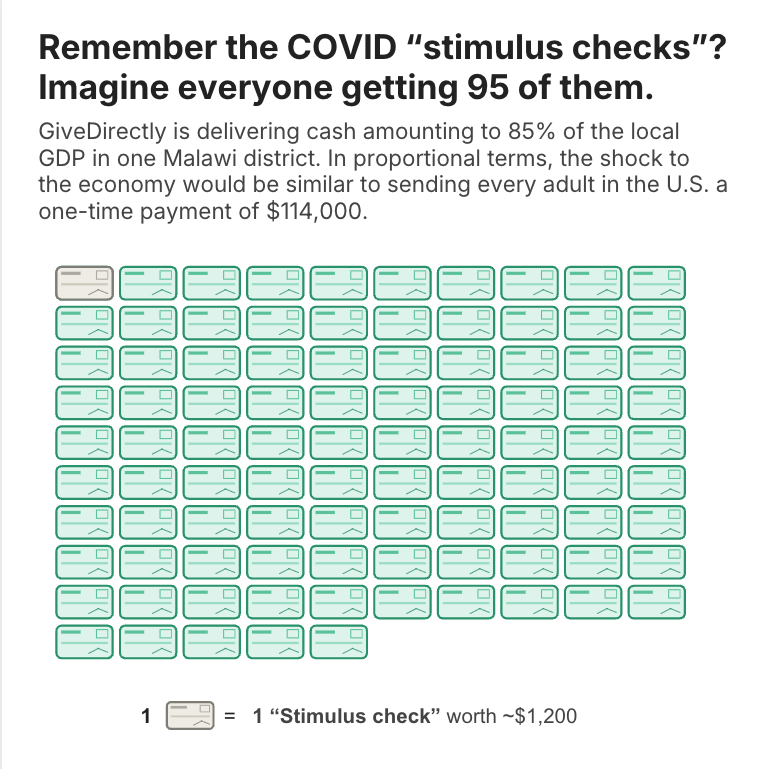
GiveDirectly is already in the midst of delivering its largest cash program yet across two of Malawi’s poorest rural districts. By the end of 2026, roughly 120,000 households will be enrolled to receive a one-time, no-strings-attached cash payment. In the areas receiving cash, the total amount delivered will equal ~85% of local GDP.
The magnitude of this shock to the local economy is hard to overstate. In proportional terms, the amount of cash is like giving every adult in the United States a one-time payment of $114,000. You would feel it, your neighbors would feel it, and so would your niece who just graduated from college, and all of her friends.
That kind of scale is what makes this micro/macro learning agenda possible. We can test whether the effects we saw in Kenya hold as cash reaches much more of an economy in a different context, and use these insights to think about what might happen as we scale in future contexts.
This also creates rarer opportunities to test how individual behavior shapes the economy-wide effects. For example, we’re giving labeled grants to ~1,650 Malawian businesses so they can stock inventory and expand, and testing whether giving businesses advance notice of when cash will land helps them prepare for the surge in demand. This tells us more than whether those added supports “work.” It helps us see how businesses respond when more customers suddenly have money to spend, and whether access to extra capital changes that response.
We’re also testing whether other additions–such as financial coaching, smartphones, and more–make the effects of cash more likely to last, and more frequent surveys will help us see how and when those changes unfold as the cash moves through the economy.
📈 More on what I mean by “economic growth”
Economic growth usually means an economy is producing more goods and services, translating to higher household income and consumption, over time. GDP is the standard measure, but changes in the number reflect underlying changes in how economies produce goods and services: workers becoming more productive, businesses growing, wages rising, and people moving into better-paying work in new sectors of the economy.
Economists have long debated what causes growth. The most famous success stories, including countries like South Korea and Taiwan, involved industrial policy, exports, and major shifts from agriculture into manufacturing and services. But that path has been difficult to replicate.
Testing cash at scale lets us test whether a large cash program can increase demand, investment, and economic activity from the bottom up, and under what conditions that can spark wider economic transformation.
Our research is filling a gap between what “works” at the micro level and what grows economies
For most of my career, I have been a dyed-in-the-wool applied microeconomist, squarely in the group that evaluates individual programs. But working on GiveDirectly’s learning agenda has convinced me that these questions were never really separate–they only look that way because we’ve rarely had programs big enough to study both at once. GiveDirectly’s growing scale is starting to change that.
Economies are made up of people, households, firms, and markets. If cash changes how enough people spend, save, work, invest, and take risks at the same time, those individual choices may add up to something much larger than any single household’s gains.
Our largest programs now give us the chance to watch that process unfold (or fail to) at far greater scale, in far greater detail, across contexts.
Results from this study could reshape how governments and donors spend billions
The stakes here go well beyond one program in one country. Progress against extreme poverty has stalled globally, and the sector is in urgent need of scalable solutions.
If cash delivered at sufficient scale creates lasting gains in jobs, businesses, markets, and incomes–under certain conditions–it gives governments and donors a tool they can deploy not just to improve lives at the margins, but to help spark growth from the bottom up.
If it does not, that is just as important to know. It would clarify where cash is powerful, where it is not enough, and what else communities need to leave poverty behind for good.
Either way, Malawi is just the beginning of a larger agenda. Each new program at scale, in a new context, brings us closer to answering the question this sector ultimately has to face: not just how to improve lives in poverty, but what it would take for whole places to leave poverty behind.