Direct cash is proven to reduce poverty.
‘You can’t just give cash to poor people!’ An idea once considered crazy has now become globally mainstream. More than two thirds of countries run cash transfer programs. This is not by chance – the evidence on positive impacts of cash transfers is overwhelming.
Hundreds of studies confirm that ‘no strings’ cash…
Giving cash with no strings attached improves multiple dimensions of people’s lives.
More than 200 independent studies and several meta-analyses (which combine multiple study findings) have been carried out on ‘no strings attached’ cash over the last two decades. Cash has the largest and deepest evidence base of all anti-poverty programs (with over 1,000 studies on cash as a whole).
The evidence confirms that direct cash given to people in poverty improves multiple dimensions of people’s lives – typically all at the same time.
Large lump sum cash with no strings attached:
- 💸 Reduces poverty – immediately and years later by increasing income, consumption, assets, and self-employment of those receiving cash, while also increasing business revenues for others in the local community.
- 🙂 Improves health and wellbeing – through better mental health, food security and food spending for those receiving cash.
- 👶 Improves children’s lives – by reducing infant mortality and increasing child height (‘height-for-age’) and school enrolment and attendance for children in households receiving cash.
Cash delivered as large lump sums (rather than small recurring payments) generates sustained poverty reduction.
GiveDirectly sends unconditional cash transfers—typically $1,000—to families in extreme poverty. Unlike typical social protection programs that send small, regular payments, we provide cash in large, one-time lump sums. This design matters because it leads to different outcomes.
Both approaches help people meet basic needs (things like food, clothing, or shelter). But independent research shows that lump sums, particularly those large in size, also facilitate investments that lead to sustained reductions in poverty even many years later.
Here’s why it works:
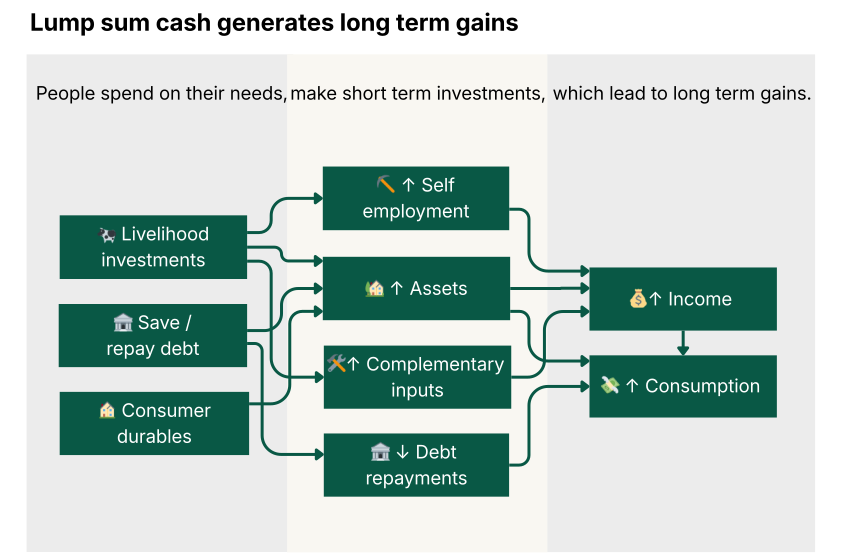
With large lump sums, people use their cash to invest in their livelihoods (things like buying livestock, tools, or supplies for a store), save or repay debt, and invest in consumer durables (such as upgrading to a tin roof or buying furniture).
As a result, people work more hours for themselves and have more assets (such as money, housing, or livestock) and complementary inputs (things like tools or transport) for their livelihoods.
These in turn increase income and consumption (i.e. spending on basic needs) both immediately and many years later.
Increases in consumption, income and assets are sustained more than 5 years after people receive a large lump sum of cash. The longest study shows increased income (of +20%) and employment up to 12 years after cash is received.
Cash benefits the whole community, not just those receiving cash.
The economic impacts of cash ripple outward. As people spend money locally, businesses grow, hire more workers, and restock more goods. Business owners, in turn, spend their earnings locally. These “cash multipliers” grow the local economy and increase incomes for non-recipients too.
Across multiple studies in sub-Saharan Africa, every $1 of cash delivered resulted in $1.50 to $2.50 of total economic activity.
Cash often outperforms traditional anti-poverty programs.
Cash empowers people to solve multiple problems at once, and it can even outperform aid programs designed to improve a single outcome.
When the same amount spent on a traditional aid program is given instead as direct cash to people, the impacts are sometimes larger:
- In Rwanda, cash improved employment more than job training and child nutrition more than nutrition counseling and WASH programs.
- In Yemen, households receiving cash had better diets than those receiving food aid.
Early concerns about direct cash haven’t held up.
What about fraud, inflation, or people wasting money? Do people stop working? Spend on alcohol?
Study after study shows these fears are overblown or untrue. People use cash responsibly to improve their lives.
We know that direct cash can’t do everything, but it does many things well.
Direct cash cannot solve collective action problems. It can get people to a school or clinic, but it cannot fix poor education or health systems. It can help someone improve their home but it cannot pipe government water systems to that home.
- Cash isn’t the solution: where infrastructure (like building schools, roads or health facilities) needs to be built or where government systems need reform.
- Cash works best as a complement: where outcomes (like improved health or educational attainment) are conditional upon functioning public services.
- We’re still learning how best to use cash: in promising areas like climate adaptation and infant mortality where more evidence is needed on cost-effectiveness and optimal program design.
But direct cash remains the most consistently effective way to reduce poverty and improve multiple areas of people’s lives.
We’re constantly learning and testing ways to increase cash’s impact.
We don’t stop at delivering cash – we study how to increase its impact. We followed the impact evidence and shifted exclusively to large lump sums, and we are learning more about how and when to deliver cash for more impact.
Here are some of the areas GiveDirectly is currently exploring:
Don’t just take our word for it though.
Read what others say about the evidence on how cash transfers impact people’s lives: