Recognizing and Reporting Scams
Is GiveDirectly a scam?
No, GiveDirectly is a legitimate international charity that has delivered over $1 billion to more than 2 million people worldwide in the last 10+ years.
We are highly rated by Charity Navigator, GiveWell, and Charity Watch.
What you should know
Official Website: Our only website is www.givedirectly.org.
Official Email: We only use email addresses that end in @givedirectly.org.
Social Media: Our verified profiles are linked below:
- X (Twitter) – http://twitter.com/givedirectly
- Bluesky – https://bsky.app/profile/give-directly.bsky.social
- Instagram – http://instagram.com/givedirectly
- Facebook – https://www.facebook.com/givedirectly
- LinkedIn – https://www.linkedin.com/company/givedirectly
- Tiktok – https://www.tiktok.com/@givedirectly
If you come across any other websites or social media profiles claiming to be GiveDirectly:
- Report them using the “Report” button on the platform.
- Send the link to the profile to scams@givedirectly.org immediately. You can also reach out to one of our in-country hotlines below.
How to spot a scam
GiveDirectly or its partner organizations will:
- ❌ NEVER ask you to pay money to receive funds or register for our programs
- ❌ NEVER ask you to return funds you’ve already received
- ❌ NEVER make loans or ask for repayments
- ❌ NEVER ask for your banking or financial information via phone, email, SMS, social media message, or physical mail
- ❌ NEVER contact you with job offers — legitimate jobs are listed on our careers page
- ❌ NEVER ask for money in exchange for job interviews or opportunities
- ❌ NEVER threaten you in any way
If you’re unsure about a message you received, contact us at scams@givedirectly.org. We’ll help you verify its authenticity.
Common scams to watch out for
❗ Fee for funds scam
We’ve recently learned of a scam where impersonators of GiveDirectly are contacting people through WhatsApp, Facebook, Telegram, and other social media platforms, asking for application, activation, registration, or disbursement fees in exchange for funds they falsely claim are from GiveDirectly.
Key characteristics of the scam
Impersonation: Scammers use fake names that closely resemble GiveDirectly. Common examples include:
- GIVEDIRECTLY or GIVE DIRECTLY
- GIVEDIRECT FOUNDATION or GIVE DIRECT FOUNDATION
- GiveDirectly Foundation Funds
- GIVE DIRECT FOUNDATION AID PROGRAM
- GIFT DIRECT EASTERN AFRICA FOUNDATION
Phone Numbers: The scammer’s phone number often originates from Kenya (+254) or the United States (+1).
Profile Picture: Scammer’s account profile picture is often 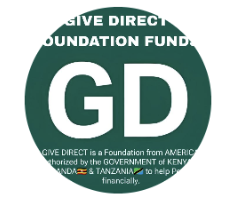

Scam Messages: These messages falsely claim that:
- You qualify for a promotion or grant and are eligible to receive funds, often in your Safaricom MPesa account.
- You need to pay an activation, registration, or disbursement fee to receive the funds.
- They may also ask for personal information such as your name, age, country, and current job.
Important reminders
GiveDirectly will:
- NEVER ask you to pay money or fees to receive funds or to register with us
- NEVER inform you of your qualification via WhatsApp, Facebook, Telegram, or any other social media messages
If you’ve been contacted by a scammer
🚫 DO NOT send any money or share further information with the scammer.
✅ DO report the scammer’s profile:
- For WhatsApp and Facebook Messenger, click into the sender’s profile, scroll to the bottom, and select “Report.”
✅ DO email us at scams@givedirectly.org to report the incident.
❗ Counterfeit check scam
We’ve recently learned of a counterfeit check scam targeting individuals in the United States, where individuals are receiving paper checks that appear to be from GiveDirectly. The counterfeit checks are printed on paper, with GiveDirectly falsely listed as the payer and received via postal mail.
GiveDirectly does not send out paper checks or payments of any nature directly to anyone without first being selected to enroll in a program.
How GiveDirectly does issue paper checks:
- The GiveDirectly team offers individuals the opportunity to receive a paper check only through its Hyperwallet payment platform once enrolled in our programs.
- If you were not selected to receive a payment from GiveDirectly and did not request a paper check through your Hyperwallet portal, you will not receive a check from us in the mail.
If you’ve received a check that you suspect may be counterfeit:
Email us at info@givedirectly.org to report the incident.
Additional guidance on avoiding counterfeit check scams can be found on the Federal Trade Commission (FTC) website.
If you think you’ve been targeted by a counterfeit check scam, report it to:
❗ Fraudulent investment scam text
We’ve recently learned of a phishing scam in which a person claiming to work for GiveDirectly reaches out asking recipients to pay money. The reason for requesting the money can vary –– two common things we have seen the scammer do:
- Falsely tell recipients that the payment they received from GiveDirectly is a loan that needs to be paid back.
- Pretend to offer an investment opportunity from GiveDirectly, Trading Corp, Capital Group, and/or One Fair Wage.
The GiveDirectly team:
- Never asks you to send GiveDirectly money in order to receive additional funds.
- Never asks you to return funds that you received from GiveDirectly. Your emergency relief payment is not a loan.
- Never offers investment opportunities. If you receive one it is fake.
__
If you have been contacted by a scammer posing as GiveDirectly, please email us at covid@givedirectly.org to report the incident.
Additional guidance on avoiding SMS phishing scams can be found on the Federal Trade Commission (FTC) website. To report a spam text message to the FTC you can copy the message and forward it to 7726 (SPAM).
Alerta: Estafa que pide devolver/invertir fondos
Recientemente nos hemos enterado de una estafa de suplantación de identidad en la que alguien está declarando falsamente ser empleado por GiveDirectly y se acerca a los destinatarios pidiéndoles que paguen dinero. La razón por la que solicita el dinero puede variar — dos cosas comunes que hemos visto hacer al estafador:
- Decirle falsamente a los destinatarios que el pago que recibieron de GiveDirectly es un préstamo que debe ser devuelto.
- Pretender ofrecer una oportunidad de inversión de GiveDirectly, Trading Corp, Capital Group, y/o One Fair Wage.
El equipo de GiveDirectly:
Nunca le ofrecerá oportunidades de inversión. Si recibe alguna oferta similar, es falsa.
Nunca le pedirá que envíe dinero a GiveDirectly para recibir fondos adicionales.
Nunca le pedirá que devuelva los fondos que recibió de GiveDirectly. Su pago de ayuda de emergencia no es un préstamo.
❗ Fraudulent employment offer letter
We’ve recently learned of a phishing scam offering freelance employment from GiveDirectly. Individuals are frequently contacted by “Michael Faye” via LinkedIn, job listings sites (ZipRecruiter, CareerBuilder, Indeed) or direct email (typically from a Gmail or Microsoft account).
The GiveDirectly team:
- Never offers employment via cold letter or email
- Only sends email from addresses that end in “@givedirectly.org”
- Requires all job seekers apply through our hiring portal.
Example: Fraudulent letter
Below is an example of the scam letter. If you have received this or similar outreach, please email info@givedirectly.org to report the incident.
—
May 13th, 2020
FREELANCE EMPLOYMENT VERIFICATION LETTER
This letter is to certify your income and employment.. You have been fully employed by GiveDirectly in association with Microsoft foundation for the COVID-19 Relief Funding Program as a Virtual Assistant handling Material and Fund distribution remotely as well as Data Entry. This employment commences Today May 13th, 2020.
GiveDirectly located on Church Street Station P.O. Box 3221. New York, NY 10008 is running this employment program as an initiative to help the un-employed rate while attending to disbursing the funds given by our donor to relief the problems families and businesses are facing due to COVID19. The employment will run from the said date above until January 1st, 2021, there after employee can apply to become a full time staff with benefits working from our newly setup office center within 50 mile of your zipcode.
Your payroll will be $1000 (Weekly) Payable via Check/Money Order. Working Hours 6 Hours daily.
This document is a (Proof of Income) supporting document to verify that the said name above is working with GiveDirectly as a freelance virtual assistant, with the primary aim of helping to reach out to affected people through us. There are NO taxes, NO benefits, No 401k and NO Insurance for this Work from Home Position. All of the information provided above and shared are well documented to our service at www.givedirectly.org. It is strictly $1000/Weekly (Monday – Friday). If you have any questions regarding the information provided on the provisional employment letter, please do not hesitate to contact:
[Fake contact info of scammer]
❗ Misleading and fraudulent charitable crypto projects
It has become common for crypto projects to include charitable elements, where some amount of their fees are given to charity. GiveDirectly has received millions in funds from such projects and appreciates the crypto community’s help in sending money directly to people in poverty.
Unfortunately, we have learned of some charitable NFT and crypto-based projects which are at best misleading and at worst could be scams. We hope the tips below will help you navigate the inherent risks.
Before donating through a charitable crypto project here are some steps to take:
1. Know who is operating the crypto project and look into their reputation. In almost every case, the project owners have the ability to keep the funds for themselves or could lose the funds to hackers. Ultimately, you have to trust them to be accountable for your donation.
- For example, we’ve been approached by projects falsely claiming that their smart contract proves they will send money directly to GiveDirectly. However, a security audit revealed that the authors could rewrite the behavior of the smart contract to send the money to whomever they wish.
- Look into the project’s founders, social media, and past blockchain transactions. Look for claims of fraud, or for brand new addresses or accounts that have limited past history.
2. Ask for specifics from the organizers. What percentage of the funds go to which charities? Do these percentages vary over time? When will the funds be released?
- Make sure the project is clear about what percentage of funds are used for charitable purposes, as well as how and when the funds will be sent to GiveDirectly.
- It may be a red flag if a project uses smart contracts to perform most of its function on the blockchain but has a less secure and transparent process for sending funds to GiveDirectly. Probe deeper to understand if they have convincing reasons for this discrepancy.
3. Contact us at info@givedirectly.org to ask if we are aware of the project before donating. We can’t endorse that any particular project is safe, but we can let you know if they have a history of working with us. Organizations we’ve previously worked with include:
- Glo Dollar
- Endaoment
- LaunchNodes
- The Life You Can Save Australia
The lowest risk and lowest fee way to give crypto to GiveDirectly is to send funds directly to our addresses listed here or through our Give Now page.
How to report a scam
If you suspect a scam, email us at scams@givedirectly.org. Include screenshots and any details like the email address, social media handle, or phone number involved. We investigate all reports.
Or, call one of our in-country hotlines:
🇨🇩 DRC
Airtel phone: +243 996 042 030
Vodacom phone: +243 815 583 244
🇯🇲 Jamaica
🇰🇪 Kenya
Phone: +254 800 720406
🇲🇼 Malawi
Phone: +265 634
🇲🇿 Mozambique
Phone: +258 85 13333
🇵🇭 Philippines
🇷🇼 Rwanda
Phone: 2009
🇺🇬 Uganda
Phone: +256 800 220 550 or +256 800 320 550