Cash Relief for Ebola-Affected Families in DRC
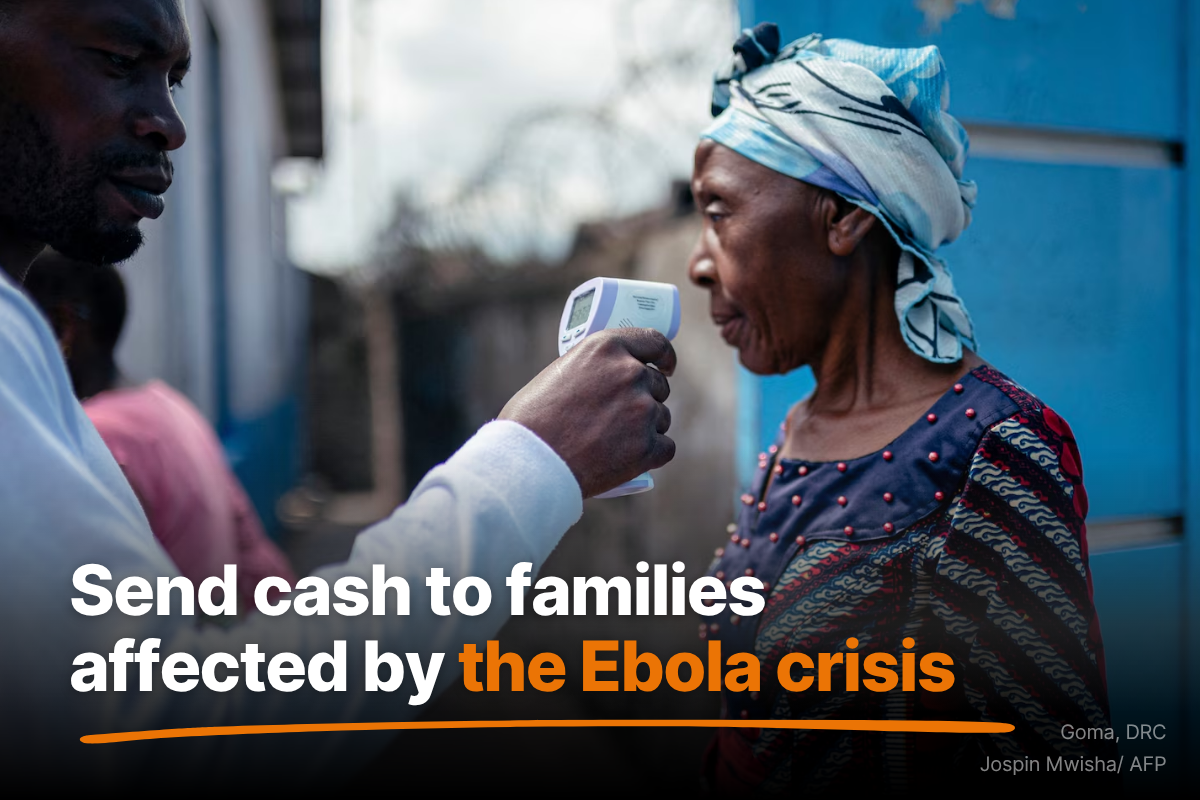
Our team is evaluating options to deliver cash to affected families in DRC, and will update this page when we have more info.
You can send funds directly to families impacted by the Ebola outbreak in the Democratic Republic of Congo.
On May 5, a new Ebola outbreak was detected in northeastern DRC. Following hundreds of confirmed cases and over 100 deaths, the World Health Organization declared it a Public Health Emergency of International Concern — one step below a pandemic declaration. There is no approved vaccine or treatment for this strain of Ebola.
In a region where most families rely on daily wages to survive, an Ebola diagnosis means weeks of lost income with no safety net. Cash changes that.
We’re mobilizing to get cash to families in the hardest-hit areas of DRC.
GiveDirectly is partnering with the DRC Ministry of Health at the provincial level (DPS) to reach families of patients who test positive with Ebola. Enrolled families will receive $675 each to help cover lost wages, replace belongings destroyed during disinfection, and recover livelihoods after treatment.
Your donation reaches families without anyone having to gather in person, which matters in an outbreak.
In an infectious disease outbreak, in-person aid distribution creates its own risks. Cash transfers reach families without requiring gatherings that could accelerate spread. See how it works:
GiveDirectly has been delivering cash in DRC since 2018, sending $13.6M in cash to 67,000+ people across the country, including in Ituri, the province at the center of this outbreak.
Cash complements what first responders do.
Many international organizations like the WHO and MSF are doing critical work containing this outbreak. But their mandate is the medical emergency. The economic impact — 21 days in quarantine with no income, destroyed belongings, waiting outside treatment centers unable to work — falls on families alone. Cash fills that gap.
Cash aid allows survivors to meet their own needs rather than having others guess what they might need, which is why people impacted by a crisis say they prefer cash relief over donated goods.
Our goal will help reach hundreds of families. With more, we could reach thousands.
This response is part of GiveDirectly’s broader effort to get emergency cash to families within five days of any crisis, anywhere in the world. Read more here.
Press



Frequently Asked Questions
Who is eligible to receive money?
We are preparing to reach families of patients who test positive with Ebola, identified via referral lists from the DRC Ministry of Health at provincial level (DPS).
Our current response is focused on DRC. If the outbreak worsens in Uganda or spreads further, we will assess how to expand our reach.
How will you deliver cash in an active outbreak zone?
We are designing this response to be fully remote, using mobile money to reach affected households without requiring any in-person contact from staff or recipients.
When a patient tests positive with Ebola, the DRC Ministry of Health at provincial level (DPS) collects emergency contact details for next of kin. DPS will share that contact information with GiveDirectly so our call center can reach out to those families and invite them to enroll in our program. Cash arrives via mobile money—no in-person contact required.
How quickly can you get cash to families?
We’re not rushing this. Since the outbreak was declared, we’ve worked in close coordination with health authorities to ensure that we complement the broader public health response.
In early July, we signed an MOU with the DRC Ministry of Health at provincial level (DPS) to start identifying and reaching families of confirmed Ebola patients. The technical setup will take about 2-3 weeks before we start enrollment and deliver payments.
What if we raise more or less than the fundraising goal?
Any excess funds will allow us to reach more families. If for any reason we are unable to deliver all funds to Ebola-affected families, donations will be delivered to survivors of the next emergency.
How much will each family receive?
Enrolled families will receive $675 each to help cover lost wages, replace destroyed belongings, and recover livelihoods:
- Hospitalization support: $75 over 3 weeks
- Asset replacement support: $300 one-time payment
- Income recovery support: $300 over 3 months
When will people receive my donation?
We’re coordinating with DPS and completing technical setup before launching enrollment and delivering payments. We’ll update this page as the timeline is confirmed.
What is GiveDirectly?
We’re a nonprofit that lets you send money directly to the world’s poorest, no strings attached. In the last decade, we’ve delivered cash to over 2 million people across 15 countries, and we research the impacts it can have for families in need.
What if I’d like to make a major gift?
We’d love to hear from you! Reach out to us at info@givedirectly.org.
Is my donation tax-deductible?
Yes, donations are tax-deductible in the United States. We accept all major credit and debit cards, PayPal, checks, wires, stocks, cryptocurrencies, and more.
If you’re giving outside the U.S., you can still give to this campaign, but your gift may not be tax-deductible. Reach out to us at info@givedirectly.org with any questions or for more information on ways to give.